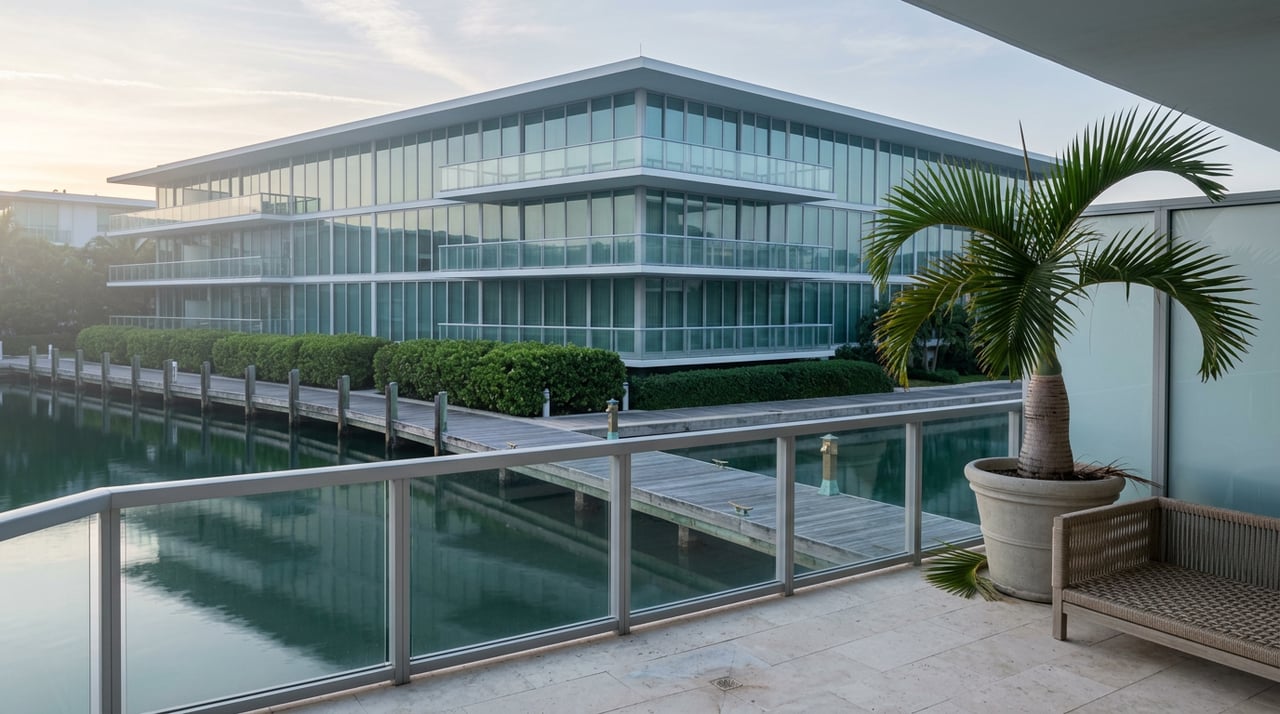
Fisher Island Just Ran Out of Land. The Fight Over What's Left Is in Court.
September 3, 2026
September 3, 2026
Ask most Miami brokers how much buildable land remains on Fisher Island and the answer has always been the same: almost none, which is the whole point of owning there. As of late summer 2026, the honest answer is closer to "none, unless a judge says otherwise." That distinction is not a technicality. If you are underwriting Fisher Island against Bal Harbour, Brickell, or any other waterfront address where new supply is mostly a permitting question, you need to understand that on Fisher Island, supply has become a legal question instead.
The outcome of one dispute over a century-old fuel depot will decide whether the island's inventory count stays frozen at its current level for years or whether one more tower eventually gets built.
Six Fisher Island topped out in March 2026. When it delivers, likely in late 2026 or early 2027 depending on which timeline you trust, it will bring 50 residences across 11 stories, with a private marina, resort pool, spa, and pricing that runs from roughly $15 million to $90 million or more for the largest layouts. STARR Restaurants, the group behind Miami's Makoto and Pastis, is curating the building's dining program.
None of that is the interesting part. The interesting part is that Six Fisher Island sits on essentially the last parcel of developable land the island has, short of one exception. Once its units close, the island's ground-up construction era ends, not because a developer chose to stop building, but because there is nowhere left to build. Buyers treating Fisher Island as a market with a normal development pipeline, the way you would in Edgewater or Brickell where new towers announce every year, are working from the wrong mental model. Here, the pipeline has an end date, and that end date is close.
The exception is the one that is currently in court.
On the island's north shore sits a 9.6-acre fuel depot that has supplied PortMiami's cruise fleet for close to a century. In October 2025, a Chicago-based developer called HRP Group closed on the purchase of that parcel for $180 million, with a plan to demolish the storage tanks and put up two 13-story condominium towers. As part of the deal, HRP signed an agreement to convey roughly four of the ten acres to the Fisher Island Community Association, the nonprofit representing the island's more than 800 property owners.
Miami-Dade County had a competing interest. The depot fuels the cruise industry, one of the region's largest economic engines, and losing it wasn't something county officials wanted to risk. Talks between the county and HRP stretched on for months, and by late May 2026 the two sides had apparently landed on terms: $200 million paid upfront, plus another $200 million spread over 20 years, for a total of $400 million to preserve the depot rather than let it become housing.
Then it fell apart. Mayor Daniella Levine Cava said she wasn't briefed on the full terms until the weekend of May 30 and 31, and once her deputy mayor flagged a 1978 covenant restricting part of the property to fuel-related use, a covenant that would require a two-thirds commission vote to remove, she called off the deal, saying the price was too high. HRP disputed that the covenant even applied to the land it planned to develop.
Four days after those talks collapsed, the Fisher Island Community Association and the Fisher Island Club sued HRP, arguing the developer's side conversations with the county violated its original commitment to the island and demanding HRP honor the plan to remove the depot and build residential. Weeks later, on June 16, 2026, the county commission voted 11 to 1 to pursue acquiring the site by eminent domain instead of negotiating further. Commissioner Raquel Regalado cast the lone no vote, warning that the decision would shape the county for the next 50 years. On July 21, the commission formally adopted a resolution declaring the acquisition a public necessity, opening the door to a forced sale.
Real estate attorney Jason Brooks, who is not involved in the litigation, told reporters that if the county wins, it will likely end up paying substantially more than the $400 million deal it just walked away from, once the appraisal fight and required safety upgrades to the depot are factored in, and that the process could drag on for years given the wealth and legal resources on the island's side.
"I do think they're going to be in for a real fight because of the wealth on the island and the contract that exists."
For a buyer, the practical translation is this: the site that would have added the island's next new inventory is now sitting inside a Fifth Amendment eminent domain case, with a parallel breach of contract suit running alongside it. Nobody involved has offered a realistic timeline for resolution, and the two outcomes point in opposite directions. If the county wins and keeps the depot, the island's supply is capped where it stands once Six Fisher Island closes. If HRP prevails and the original development deal survives, two more towers eventually get built. Either way, the answer isn't a market decision anymore. It's a docket number.
Fisher Island's other quirk, and one that predates the fuel depot fight, is how unstable its own price data is. Pull the island's median sale price from different tracking windows in mid-2026 and you get different markets.
| Time window | Reported median | What it's counting |
|---|---|---|
| Three months ending May 2026 | $7.8 million | 8 homes sold in May 2026, down from 12 a year earlier |
| April 2026 | $25.5 million | 10 homes sold, up from 7 a year earlier |
| Early 2026, blended brokerage estimate | Roughly $9.5 million, about $3,400 per square foot | Recent high-end trades, weighted toward Palazzo-building sales |
Those aren't rounding errors. They're the predictable result of a market where only a handful of trades close in any given month and a single sale at the Palazzo del Sol or Palazzo della Luna can swing the whole reported average. One month you get eight sales weighted toward smaller units and the median reads $7.8 million. The next month a couple of larger closings push it past $25 million. By June 2026, active listings on the island had fallen to just five according to Southeast Florida MLS data published that July, which shows how few opportunities exist at any given moment to even set a fresh comparable.
Days on market moved in the same direction as prices, which is the part worth sitting with. The average climbed to roughly 267 days in the three months ending May 2026, nearly triple the 90 days recorded a year earlier, even as headline prices were reportedly rising. That combination, longer time on market alongside a higher median, is not a contradiction. It's what a thin market looks like when a handful of large, infrequent trades are doing all the work. If you're comparing Fisher Island's median to a market like Brickell, where hundreds of units trade in a comparable window and the number reflects broad demand, you're comparing a stable statistic to a volatile one. Fisher Island's median tells you what a small number of sellers accepted this quarter. It does not tell you what your unit is worth.
Fisher Island also lost the title of America's most expensive ZIP code in 2026, ceding the top spot to Atherton, California, where a wave of AI-driven wealth pushed the median past $10 million in the first half of the year, up roughly 20 percent year over year. Losing that ranking says more about how thin these rankings are at the very top of the market than it does about weakening demand on the island itself.
The other detail buyers tend to miss is that "Fisher Island" isn't governed as one entity. The Fisher Island Community Association reports that, alongside the Fisher Island Club, the island contains 21 separate condominium associations plus two homeowners associations, Valencia Estates and Links Estates. Every owner answers to FICA's master covenants and to the specific rules of whichever of those 23 associations their building falls under.
There is no island-wide rental policy. Minimum lease terms, how many leases are allowed per year, board approval requirements, and fees all vary by building. Given that the island's own club puts total residences at around 800 while the most recent census counted only 197 households living there full time, a large share of Fisher Island's units function as second homes or investment properties rather than primary residences, which makes each building's specific leasing rules more relevant to a buyer's plans than any island-wide reputation for exclusivity. Before a purchase contract's statutory review period closes, get the actual declaration and current rules for the building in question rather than relying on what the island as a whole is known for.
Every ultra-luxury Miami market sells scarcity. Fisher Island is the rare one where scarcity is now a matter of pending litigation rather than marketing copy. Six Fisher Island will be the last building anyone builds on the island unless a court, an appraisal process, and a multi-year legal fight over a fuel depot resolve in a very specific direction. Until that resolves, the honest way to value a Fisher Island purchase is to treat today's inventory as close to fixed, treat the headline median with real skepticism given how few trades set it, and verify the specific building's rules rather than the island's reputation.
If you're weighing Fisher Island against another waterfront address in Greater Miami, or you want the current state of the fuel depot case explained in the context of a specific unit or building, Four Corners Real Estate can walk you through what it actually means for your purchase. Request a Private Consultation.
Will Fisher Island ever have new construction again after Six Fisher Island? Only if the fuel depot site is eventually redeveloped as originally planned. That depends on the outcome of the ongoing eminent domain case and the related lawsuit between HRP Group and the Fisher Island Community Association and Club. As of this writing, neither side has offered a resolution timeline.
Does the fuel depot dispute affect the value of units that have already closed? The dispute concerns future supply on the island, not the physical condition of existing buildings. What it does affect is how a buyer or appraiser should think about scarcity going forward, since the total number of residences the island will ever hold is currently undetermined.
Why do different sources report such different median prices for Fisher Island? Because so few homes sell there in any given month, a single large transaction can swing the reported median dramatically from one period to the next. A meaningful comparison requires looking at actual closed comparables in a specific building, not a blended island-wide figure.
Is Fisher Island's HOA the same across the whole island? No. The island has 21 condominium associations and two homeowners associations, each with its own declaration covering leasing, fees, and approval rules. Buyers should request the specific building's governing documents rather than assume island-wide terms.
Stay up to date on the latest real estate trends.

Ready to find your next investment or dream home? Whether you’re building a portfolio or looking for the perfect residence, we’re here to deliver clarity, strategy, and results.