In Coconut Grove, the Median Price Is Measuring the Wrong House
September 3, 2026
September 3, 2026
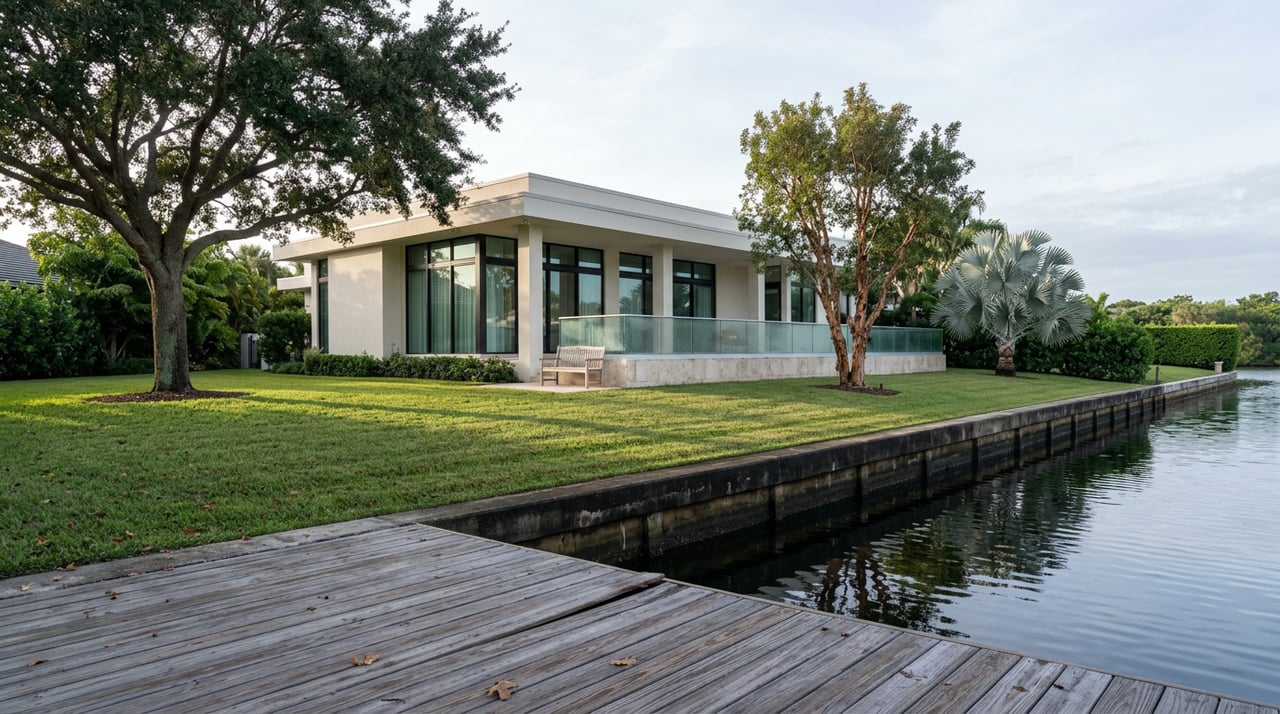
In January 2026, a waterfront estate on Munroe Drive closed for $71.9 million. At 10,400 square feet, that works out to just under $6,913 a square foot, a price-per-square-foot figure Coconut Grove had never posted before. Coverage of the same window reported that Google co-founder Larry Page closed on a second Grove waterfront property in roughly that range that month, following an earlier purchase widely reported near $101.5 million for a compound known as Banyan Ridge. Together the two deals put more than $170 million into a stretch of shoreline most of Miami still associates with sailboats and banyan trees rather than nine-figure wire transfers.
That single transaction on Munroe Drive is also, statistically, the reason the rest of the Grove's price data looks confusing right now. A three-bedroom foursquare two blocks inland is not selling for anything close to the neighborhood's reported median. It never was going to. The median itself has stopped describing a typical house.
Over the three months ending in June 2026, the median sale price for a Coconut Grove single-family home rose roughly 53 percent compared to the same period a year earlier. If that were the whole story, it would mean the Grove out-appreciated nearly every other Miami neighborhood in a single year. But the median price per square foot over that same window moved only about two tenths of one percent.
That gap is the tell. When the median jumps 53 percent and the price per square foot barely moves, the market did not get 53 percent more expensive. The mix of what happened to close did. A handful of large lots and waterfront trophies traded, an ordinary run of mid-size inland homes did not, and a thin monthly sample did the rest. Coconut Grove sells somewhere between a few dozen and a few hundred single-family homes in any given quarter, small enough that one $71.9 million closing can drag the whole neighborhood's headline number wherever it wants to go.
For a buyer comparing the Grove against Coral Gables or Pinecrest, this matters more than it sounds. The reported median tells you what happened to sell. It does not tell you what a comparable house on a comparable lot is likely to cost you next month. The number worth tracking is price per square foot on a similar lot size and location, not the neighborhood-wide median that a single trophy closing can bend.
The mix-shift problem compounds a second, quieter one: there simply are not that many Grove houses coming to market in the first place.
Florida's Save Our Homes provision caps the annual increase in a homesteaded property's taxable assessment at 3 percent, regardless of how much the market value has climbed. In a neighborhood where roughly seven in ten single-family homes are homesteaded, and more than a third have been held for over a decade, that cap has quietly built a tax basis most owners have no financial reason to give up. Sell the house, and the new owner's assessment resets to current market value, at 2026 prices, not the frozen basis the seller enjoyed. The tax consequence of moving is real enough that it keeps long-held Grove homes off the market even when a seller could clearly get a strong price.
This is not a scarcity story about buyers competing for a fixed supply of desirable lots. It is a scarcity story about a specific state tax mechanism giving owners a financial incentive to sit still. A neighborhood can have rising demand and flat or shrinking inventory at the same time, and in the Grove right now, it does.
The lock-in effect explains why so little comes to market. What actually trades tells you something else: on a large share of Grove parcels, the land underneath the house is now worth more than the house.
Property records reviewed across the neighborhood show land value exceeding total tax assessment on the large majority of single-family parcels, with several hundred identified as strong teardown candidates and more than two hundred of those carrying land values above $1 million on their own. One parcel on Main Highway alone carries close to $51.8 million in land value before anyone accounts for whatever structure sits on it.
In a growing share of Coconut Grove sales, the improvement on the tax roll is the least valuable part of what changed hands.
That reframes what a buyer is actually underwriting. A listing price on an older Grove home is rarely a statement about the house's condition or square footage. It is a statement about a 7,500-square-foot median lot, in a neighborhood with no new land to create more of it, that happens to have a structure standing on it for now. Buyers who evaluate a Grove listing the way they would evaluate a house in a newer subdivision, comparing finishes and floor plans, are pricing the wrong asset. The lot, its dimensions, and its position relative to the water are doing most of the work.
None of this is happening in a neighborhood that is standing still. The Grove's commercial core has changed ownership and use at a pace unusual for a place built around century-old banyan canopies.
Grove Central, the 23-story residential tower with roughly 402 apartments and a public garage next to the Coconut Grove Metrorail station, began delivering residents in 2024 and has since expanded the neighborhood's rental and retail footprint. CocoWalk's owners added a five-story office building, One CocoWalk, and repositioned the open-air retail core around a LEED Gold standard. Mayfair in the Grove completed a $37 million renovation in 2025 and, according to Connect CRE, landed a $113.6 million refinancing in March 2026 on a property that is now 98 percent leased. Part of that leasing momentum came from IT-security firm Iru, formerly Kandji, which according to Hoodline signed roughly 92,000 square feet across two buildings inside the complex in early 2026, one of the larger office leases in Miami so far this year.
On the residential side, Vita at Grove Isle delivered 65 condominium residences from veteran developer Ugo Colombo's CMC Group, and the Four Seasons Residences is now selling preconstruction in the $3,000 to $4,000 per square foot range ahead of a targeted 2028 delivery. Hospitality ownership has turned over as well. Gencom reacquired the Ritz-Carlton Coconut Grove from Hersha Hospitality Trust in late 2025 or early 2026, and the Mayfair House Hotel & Garden sold for roughly $110 million to Elliott Investment Management and Lifestyle Hospitality Capital Group in a deal that closed in mid-2026, according to reporting from Coconut Grove Magazine.
Every one of those transactions represents an institutional buyer underwriting years of return on a neighborhood whose core scarcity, tight tax-driven inventory and a shrinking supply of undivided land, is not going away. That is a different kind of confidence than a hot median, and it is a big part of why the ceiling has kept resetting even while the middle of the market moves at its own, slower pace.
A buyer weighing a specific Grove property against the neighborhood's headline numbers is better served by three questions than by the median.
First, what is the land worth relative to the improvement, according to the county's own assessment. A property where the structure carries most of the value is a different bet than one where the lot does.
Second, how long has the current owner held the property, and is it homesteaded. That is a rough proxy for how much of a tax-basis penalty they are giving up to sell, which in turn tells you something about how firm they will be on price.
Third, for waterfront specifically, be ready for a longer clock. Recent data on Grove waterfront listings shows a median of roughly 114 days to go under contract, more than double the neighborhood's typical pace, even as sellers still accept a standard discount near 9.4 percent off list. Waterfront in the Grove costs a buyer time, not necessarily a premium over asking.
None of these numbers replace a walk-through with someone who knows the specific block. But they are a better starting filter than a neighborhood-wide median that one $71.9 million closing can move on its own.
Does Coconut Grove's reported median predict what I'll pay for a specific house? Not reliably. The median moves with the mix of what happens to sell in a given quarter, and Coconut Grove's monthly sales volume is small enough that one large trophy transaction can swing it. Price per square foot on a comparable lot size is a steadier reference point.
Why is inventory so tight if prices keep climbing? A large share of Grove owners hold homesteaded properties protected by Florida's Save Our Homes assessment cap. Selling resets their taxable basis to current market value, which gives many long-term owners a financial reason to stay rather than list, independent of what the market would pay them.
Is a lower price per square foot on an older Grove home a sign of a deal? Often it signals the opposite: a structure that contributes little to the price relative to the land beneath it, and a strong candidate for renovation or a rebuild rather than a bargain on livable square footage as-is.
Coconut Grove's numbers reward a buyer who reads past the headline. If you are weighing a specific address against what the market is actually doing on that block, block by lot by tax record, Four Corners Real Estate can walk you through the county data on a property you are considering, alongside a founder-led read on what the Coconut Grove market is really pricing right now. Request a Private Consultation, or start with a current home valuation if you are weighing whether this is the window to sell.
Stay up to date on the latest real estate trends.
Ready to find your next investment or dream home? Whether you’re building a portfolio or looking for the perfect residence, we’re here to deliver clarity, strategy, and results.