Relocating to Miami FL: Complete Guide for Luxury Buyers & Families
Relocating to Miami Four Corners Real Estate March 17, 2026
Relocating to Miami Four Corners Real Estate March 17, 2026
Relocating to Miami, FL is one of the most deliberate financial and lifestyle decisions a high-net-worth buyer can make today. For a growing number of executives, families, and international investors, it has become far more than a move. The combination of zero state income tax, a booming luxury real estate market, world-class amenities, and a quality of life that is difficult to find elsewhere has turned relocation to Miami into one of the most significant real estate trends of the past five years.
If you are considering a move, this guide covers everything you need to know: why people are choosing Miami right now, how to choose the right neighborhood, what the financial picture looks like, what families should know about schools and lifestyle, and how the buying process works for relocation buyers.
The drivers behind Miami's relocation surge are structural, not cyclical. Several converging factors have made moving to Miami one of the most financially rational decisions a high-income household can make.
Florida has no personal state income tax. For a household earning $500,000 or more annually, the annual savings compared to living in New York, California, or Illinois can run well into six figures. Over a decade of residency, this single factor can represent millions of dollars in preserved wealth. Many buyers who initially considered a second home in Miami ultimately relocate as a primary residence once they run the numbers.
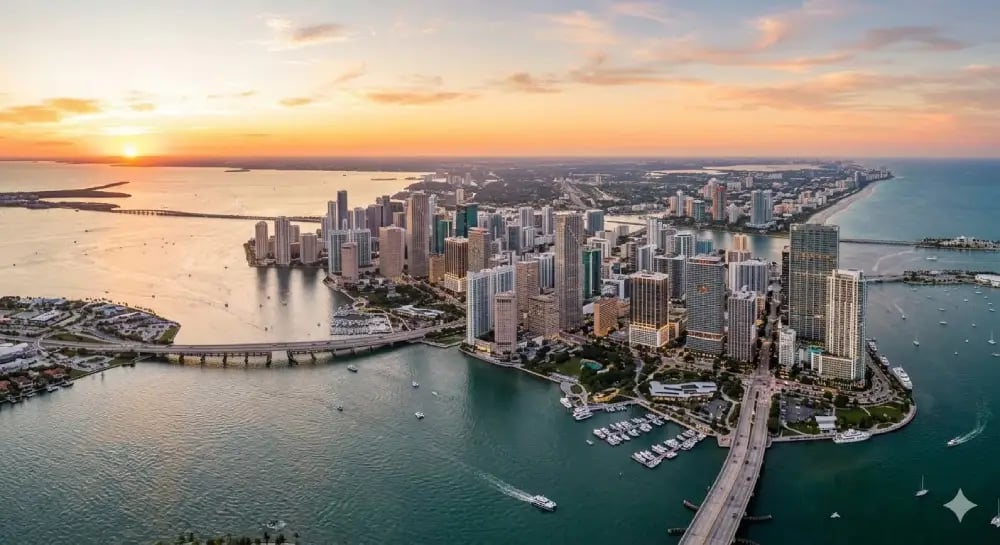
Miami has evolved from a tourism and real estate economy into a diversified financial and technology hub. Major hedge funds, private equity firms, and tech companies have established or relocated significant operations to the city, bringing with them a wave of C-suite executives and senior professionals who need high-end housing quickly. Brickell, in particular, has earned its reputation as the Wall Street of the South.
Miami International Airport offers direct connections to every major U.S. city and serves as the primary gateway to Latin America and Europe. For international buyers and executives who travel frequently, relocating to Miami offers a quality of life that balances work demands with a genuinely exceptional place to live.
Bordered by the Everglades to the west and the Atlantic Ocean to the east, Miami cannot expand outward the way inland cities can. This structural constraint on new supply, combined with sustained domestic and international demand, has made Miami real estate one of the most resilient markets in the country for long-term value.
Key stat: Sales of luxury properties priced above $1 million surged more than 21% year-over-year in January 2026, driven largely by buyers relocating from New York, Chicago, and California.
Relocation to Miami is different from a typical local move. The buyers we work with are typically coming from another major city, often under time pressure, and making decisions about neighborhoods and buildings they may have only visited a handful of times. A few things to know before you begin. before you begin.
Miami offers a range of luxury neighborhoods, each suited to a different type of buyer. Below is a practical overview from a relocation buyer's perspective. You can explore all of our Miami neighborhood guides for more detail on each area.
Brickell is Miami's financial district and the neighborhood of choice for professionals relocating from cities like New York or Chicago. It is walkable, transit-connected, and dense with luxury high-rises offering full-service amenities. Explore Brickell for current listings and neighborhood detail. Buyers drawn to new construction will find some of Miami's most ambitious projects here, including St. Regis Brickell and Baccarat Residences.
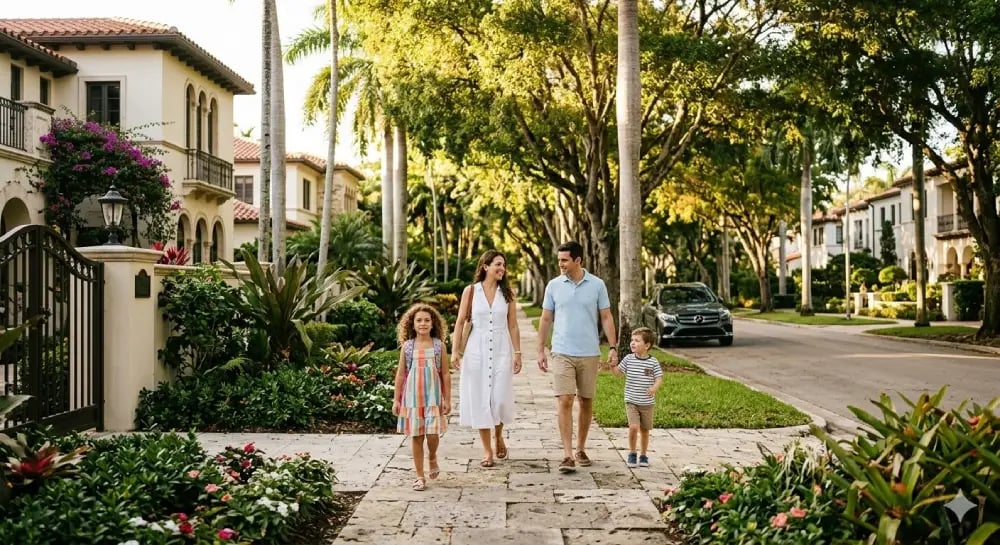
Coconut Grove is one of Miami's most distinctive and sought-after neighborhoods, offering a village-like atmosphere, mature tree canopy, and direct access to Biscayne Bay. It attracts buyers looking for a more residential feel without sacrificing proximity to the city. Families and executives who want space, privacy, and a genuine sense of community consistently rank it among their top choices. Explore Coconut Grove and see why it remains one of Miami's most resilient luxury markets. Our day-in-the-Grove guide gives a real sense of what life here looks like.
Coral Gables is the neighborhood of choice for families prioritizing top-tier schools, historic architecture, and long-term value. The city-within-a-city has its own municipal services, strict architectural standards, and a strong sense of community. It tends to attract buyers relocating with children who want access to both private and highly regarded public schools. Explore Coral Gables to see current inventory. Our detailed condo vs. house guide for Coral Gables is a useful starting point for buyers deciding between property types.
Edgewater sits between Brickell and Wynwood, offering waterfront living at a more accessible price point than Miami Beach with a younger, creative energy. It has become a strong draw for buyers relocating from cities like Brooklyn or Los Angeles who want proximity to the Design District, Wynwood's art scene, and Biscayne Bay. Our Brickell vs. Edgewater comparison helps buyers decide between the two.
Miami Beach remains Miami's most internationally recognized address, attracting buyers who want direct ocean or bay access, proximity to South Beach's cultural life, and the world-class amenities of properties like One Ocean. It is particularly popular with buyers coming from Europe and Latin America, as well as those purchasing a primary residence with the lifestyle of a second home. Explore Miami Beach or read our guide on life in a Miami Beach oceanfront condo.
Sunny Isles Beach is one of Miami's most private and exclusive coastal communities, drawing international buyers, second-home purchasers, and families who want beachfront living without the density of South Beach. The area has a concentration of branded and ultra-luxury towers that attract buyers looking for both lifestyle and long-term investment. See also our analysis of Sunny Isles Beach for second homes and investment.
Bay Harbor Islands and Bal Harbour offer an upscale, quieter alternative to Miami Beach, with a tight-knit residential feel and direct access to the water. Bal Harbour Shops remains one of the world's premier luxury retail destinations. Explore Bay Harbor Islands and Bal Harbour or read our Bay Harbor and Bal Harbour luxury condo guide.
For buyers relocating to Miami with family, the neighborhood decision is shaped as much by schools and daily life as it is by property type and price. Miami has a robust private school ecosystem alongside strong public magnet programs, and the right neighborhood depends heavily on the age of your children and your family's priorities.
Miami's private school landscape is among the strongest in the Southeast. Families relocating from New York or the Northeast will find a comparable range of options, from faith-based institutions to independent college-preparatory schools. Coral Gables, Coconut Grove, and Pinecrest are consistently the most popular neighborhoods for families prioritizing school access. Key private schools in the greater Miami area include Ransom Everglades, Gulliver Preparatory, Palmer Trinity, and the Cushman School, among others.
Miami-Dade County Public Schools operates one of the country's largest networks of magnet programs, including nationally ranked options in STEM, arts, and international studies. Coral Gables Senior High, Design and Architecture Senior High (DASH), and the Young Men's Preparatory Academy are among the most competitive. Neighborhood school assignments vary by address, so it is worth verifying attendance zones during your home search.
One of the most immediate quality-of-life upgrades for families moving to Miami is access to outdoor recreation year-round. Between Biscayne Bay, the beaches, and an extensive network of parks, children and adults alike find that much of daily life happens outside. Coconut Grove's waterfront parks, the trails at Pinecrest Gardens, and the beach access across Miami Beach and Sunny Isles Beach are among the most popular draws for families making the move.
Miami is one of the most internationally diverse cities in the United States, with strong communities from Latin America, Europe, and beyond. For families relocating from abroad, this diversity often makes the transition easier, as established communities from their home countries are typically already present in Miami. The city's bilingual character, particularly in Coral Gables, Brickell, and Coconut Grove, is a practical asset for families with children in international schools.
For families: Coral Gables and Coconut Grove consistently rank as the top two neighborhoods for families relocating to Miami, offering the strongest combination of school access, green space, community feel, and long-term property value.
The financial argument for relocating to Miami is straightforward and significant. Beyond lifestyle, the numbers make a compelling case on their own.
Florida is one of nine states with no personal state income tax. For a buyer relocating from New York, California, Illinois, or Massachusetts, the annual tax savings can be substantial. A household with $1 million in annual income moving from New York City to Miami saves approximately $120,000 to $150,000 per year in state and city income taxes alone, depending on their income structure. Over ten years, that figure represents a meaningful portion of a luxury property purchase.
Florida's Homestead Exemption reduces the assessed value of a primary residence by up to $50,000 for property tax purposes and, more importantly, caps annual increases in assessed value at 3% per year under the Save Our Homes provision. This becomes increasingly valuable over time as property values appreciate, keeping the tax bill from rising proportionally with the market.
Despite Miami's reputation as a luxury market, the overall cost of living for high-income households compares favorably to New York, San Francisco, or Los Angeles once the tax advantage is factored in. Housing costs at the luxury level are often comparable or lower per square foot, and the absence of state income tax more than offsets most other expense differentials.
For buyers relocating to Miami with a long-term horizon, purchasing is almost always the stronger financial decision. Miami's constrained land supply, strong international demand, and continued corporate migration have sustained price appreciation even during national market corrections. Our analysis of why renting costs more than buying in the long run covers the numbers in detail. For buyers whose move-in timeline is 12 to 24 months away, pre-construction condos offer the ability to lock in pricing now while your relocation timeline unfolds.
Buying in Miami as a relocation buyer is a distinct experience from a local purchase. Most of our relocation clients are making significant decisions with limited on-the-ground time, which makes having the right representation even more important.
The typical Miami luxury purchase involves an offer on an AS-IS contract, an earnest money deposit of 1 to 3% of the purchase price, a due diligence period for inspections and title review, and a closing timeline of 30 to 60 days for resale properties. For new construction and pre-construction, timelines vary by project. Our detailed guide on Miami closing costs for luxury buyers explains what to budget beyond the purchase price.
Not all luxury buildings in Miami are equal from a financial and lifestyle standpoint. Reserve levels, HOA financials, rental rules, and building condition all affect both your day-to-day experience and the long-term value of your investment. The true cost of ownership in a Miami luxury high-rise is an important read before you begin shortlisting buildings. Understanding the difference between warrantable and non-warrantable condos also matters if you plan to finance.
Many relocation buyers find that new construction and pre-construction developments align particularly well with their timeline. Purchasing at the pre-construction stage allows you to secure your property now, often at developer pricing, with a delivery date that can be planned around your relocation schedule. Miami's current pipeline includes some of the most compelling new development in the city's history. Explore our full Miami new construction and development listings to see what is currently available, and read our guide on what to consider when buying pre-construction in Miami before making a decision.
The most common mistake relocation buyers make is treating a Miami purchase like a local transaction. The market moves quickly, inventory in the best buildings is limited, and developer relationships are not accessible through a standard real estate portal. A specialized agent who works daily with relocation buyers, knows the developers, and understands the building-by-building nuances of Miami's luxury market is the single most important advantage you can give yourself when moving to Miami from another city.
For high-income households, relocation to Miami is one of the most financially sound decisions available. The combination of no state income tax, Florida's Homestead Exemption, strong property value appreciation, and a cost of living that is competitive with other major luxury markets makes Miami a compelling primary residence choice from a pure wealth-preservation standpoint.
Coral Gables and Coconut Grove are consistently the top choices for families relocating to Miami with children. Coral Gables offers the strongest private and public school access, historical architecture, and long-term property stability. Coconut Grove offers more of a residential village feel with waterfront access and proximity to Brickell. The right choice depends on your children's ages, school priorities, and lifestyle preferences.
Resale luxury properties in Miami typically close in 30 to 60 days from a signed contract. For buyers with a flexible timeline, pre-construction condos allow you to purchase now and take delivery anywhere from 12 to 36 months in the future, depending on the project's construction schedule. Cash purchases can close in as little as two to three weeks.
No. Many of our relocation clients complete significant portions of the search and purchase process remotely. We can provide virtual tours, detailed building analysis, and contract negotiation on your behalf. Most buyers do visit Miami at least once before committing, which we strongly recommend to ensure the neighborhood and building feel right. For international buyers, remote purchases are common and fully supported.
Beyond the purchase price, buyers should budget for closing costs typically ranging from 2% to 5% of the purchase price (covering title insurance, documentary stamps, recording fees, and legal costs), HOA fees, property taxes, homeowner's insurance, and any special assessments related to the building. Our guide on Miami closing costs for luxury buyers provides a detailed breakdown.
Yes. Despite its international reputation for nightlife and tourism, Miami has a strong family infrastructure: an excellent private school ecosystem, extensive parks and outdoor recreation, a highly diverse and welcoming community, and residential neighborhoods like Coral Gables, Coconut Grove, and Pinecrest that are quiet, safe, and family-oriented. The year-round outdoor lifestyle is a significant quality-of-life upgrade for families coming from colder climates.
Establishing Florida residency eliminates your state income tax obligation to your previous state, provided you meet Florida's residency requirements (typically spending more than 183 days per year in the state and taking formal steps to establish domicile, such as updating your driver's license, voter registration, and filing a Declaration of Domicile). We recommend consulting a tax advisor who specializes in multi-state residency changes to ensure the transition is handled correctly.
The following sources inform the data and market context referenced throughout this guide:
Talk to Four Corners Real Estate. Moving to Miami is one of the most significant financial and lifestyle decisions a buyer can make. The market rewards buyers who move with clarity and local expertise, and penalizes those who approach it the way they would a transaction in their home city.
Four Corners Real Estate are Miami's luxury real estate agents built for exactly this type of buyer. Led by founder and broker Bragi Sigurdsson, who has spent more than two decades in Miami's luxury market and has helped investors achieve average annual returns of 25%, the team brings a disciplined, data-driven approach to every relocation engagement. From sourcing the right building before it hits the market to navigating HOA financials, pre-construction timing, and neighborhood fit for your family, Four Corners is the team that has done this work before, at this level, in this market.
Whether you are relocating to Miami from New York, California, Chicago, Europe, or Latin America, we can help you get it right. Explore our available Miami luxury listings, browse our new construction and pre-construction developments, or contact the Four Corners team directly to schedule a relocation consultation.
Stay up to date on the latest real estate trends.

Ready to find your next investment or dream home? Whether you’re building a portfolio or looking for the perfect residence, we’re here to deliver clarity, strategy, and results.